TATTOO YOU
Archived recordings used from:
November 25-December 13, 1972: Dynamic Sound
Studios, Kingston, Jamaica
January 22-February 9, 1975: Rolling Stones
Mobile Unit, Rotterdam, Netherlands
October 10-December 15, 1977: Pathé Marconi
Studios, Paris, France
January 5-March 2, 1978: Pathé Marconi Studios,
Paris, France
June 21-July 7, 1979: Pathé
Marconi Studios, Paris, France
Late July-August 25, 1979: Pathé Marconi
Studios, Paris, France
September 12-October 19, 1979: Pathé Marconi
Studios, Paris, France
Overdubbed & mixed:
October 11-November 12, 1980: Rolling
Stones Mobile Unit, warehouse, Paris, France
November 25-mid-December 1980: Rolling
Stones Mobile Unit, warehouse, Paris, France
April-June 1981: Atlantic
Studios, New York City
Producers: The
Glimmer Twins
Associate producer & chief engineer:
Chris Kimsey
Mixer: Bob
Clearmountain
Released: August
1981
Original label: Rolling Stones Records (on WEA &
EMI)
Contributing musicians: Mick Jagger, Keith Richards, Charlie Watts,
Bill Wyman, Ron Wood, Ian Stewart, Sonny Rollins, Chris
Kimsey, Nicky Hopkins, Mike Carabello, Mick Taylor, Wayne
Perkins, Billy Preston, Ollie
Brown, Pete Townshend, Barry Sage,
Jennifer McLean, Susan McLean.
Start Me Up
Hang Fire
Slave
Little T&A
Black Limousine
Neighbors
Worried About You
Tops
Heaven
No Use in Crying
Waiting on a Friend
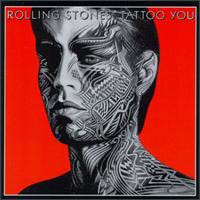
THE TITLE, COVER
& CREDITS
(We
called it Tattoo You b)ecause we had these paintings by
that guy and we just didn't know what to call it... Some friend
of mine from Pharoah Island did these paintings... they're
actually photographs but with that tattoo painting on them. I
saw him do some other stuff and we liked them so I gave him a
couple of pictures and asked him to do them like that. Then we
used them for the cover. We had lots of different titles but in
the end we decided to call it that.
- Mick Jagger, 1981
The
covers are getting worse, but the music keeps getting better.
- Keith Richards, 1981
Well, I just got fed up with writing all
those credit lists out and everyone wants one above the other
one, and then I couldn't remember who is playing, so I thought
Oh, everyone got paid anyway. So it's much easier to
leave the whole thing. I mean I didn't get any credits on it
except for the songwriting... I mean it didn't mention my name
and what I did and played on the album. If I remember well
there is Sonny Rollins on three tracks, Nicky Hopkins on one.
There's Pete Townshend.
- Mick Jagger, 1981
Obviously (Mick Taylor) didn't write
enough of them for me to give him credit. But people always
moan when they leave a band.
- Mick Jagger, 1981
CREATION
Tattoo
You really came about because Mick and Keith were going
through a period of not getting on. There was a need to have an
album out, and I told everyone I could make an album from what I
knew was still there.
- Chris Kimsey, associate
producer
I think it was one of the first albums
that we made without actually going in: We're going to
make an album and we either die in the attempt or we come
out the other end... We'd realized that over the years
we had just left a whole lot of stuff, like, trailing behind
us that we really needed to catch up on.
- Keith Richards, 2021
The thing with Tattoo You wasn't that we'd stopped
writing new stuff, it was a question of time. We'd agreed we
were going to go out on the road and we wanted to tour behind
a record. There was no time to make whole new album and make
the start of the tour.
- Keith Richards, 1993
I spent 3 months going through like the
last 4, 5 albums finding stuff that had been either forgotten
about or at the time rejected. And then I presented it to the
band and I said, Hey, look guys, you've got all this great
stuff sitting in the can and it's great material, do
something with it.
- Chris Kimsey, 1982
For Tattoo
You, Mick and Chris Kimsey realised that there was a lot
of great music that we had recorded in the past that had never
been released, particularly from all the material we had amassed
during the Emotional Rescue sessions. So they went back
and started sifting through it all, and eventually got to the
point where they got up to here with it, and said, Let's not
go any further, and used songs like Waiting on a
Friend.
- Ron Wood, 2003
Since I'd recorded a number of songs
during Some Girls and
Emotional Rescue that
they'd never used, I assumed there must be other bits and
pieces lying around. So, I spent a couple of months going
through all their tapes and I found these gems: Waiting On A Friend and Tops were from the Goats Head Soup sessions; Slave and Worried About You were
from Black and Blue; Start Me Up was from Some Girls; and Hang Fire (webmaster note: started during Some Girls), Little T&A, Black Limousine (also
started during Some
Girls) (...) and No Use In Crying were from Emotional Rescue. I did
rough mixes at Olympic of everything I'd found, sent them to
the band members, and then began working on the
tracks... The main thing missing from most of them was
Sir Mick's vocal, because he hadn't finished writing the
lyrics, so those parts were recorded in Paris in mid-1981.
- Chris Kimsey, 2004
(T)hat's an old record.
It's all a lot of old tracks that I dug out. And it was very
strange circumstances. Chris Kimsey and I went though all the
tracks from those two previous records. It wasn't all outtakes;
some of it was old songs. And then I went back and found
previous ones like Waiting on a Friend, from Goats
Head Soup. They're all from different periods. Then I had
to write lyrics and melodies. A lot of them didn't have
anything, which is why they weren't used at the time - because
they weren't complete. They were just bits, or they were from
early takes. And then I put them all together in an incredibly
cheap fashion. I recorded in this place in Paris in the middle
of winter. And then I recorded some of it in a broom cupboard,
literally, where we did the vocals. The rest of the band were
hardly involved. And then I took it to Bob Clearmountain, who
did this great job of mixing so that it doesn't sound like it's
from different periods.
- Mick Jagger, 1995
I had to write the
lyrics and finish the vocals. Then we had to do the guitar parts
and the overdubs. There were a lot of tracks that had no top
lines, like no tunes, they had no melody. But I mean I had to
write tons of lyrics, there were tracks with no lyrics, but they
were really good tracks.
- Mick Jagger, 2021
They'd
rented a bloody warehouse on the edge of the Peripherique [ring road] in
a horrible part of (Paris) - all industrial sites and train
sidings... no restaurants! I don't know who'd found the
warehouse, but it was big and cheap, they put the mobile truck
inside there, and it was so cold that, when Mick did the vocals,
you could see icy breath coming out of his mouth. I remember
that place to this day. It was absolutely diabolical.
- Chris Kimsey, 2004
It
didn't make any sense at all, aside from the fact that Mick
loved Paris and their truck was parked there inside a warehouse
that cost next to nothing. We put some screens around him,
otherwise it would have sounded ridiculous in that giant place,
and I recorded all of his vocals with a valve 47... He'd
give it the full performance, moving all over the place. It
was great to watch and equally great to record. He knows how to
work a microphone. He might be at the back of the control room,
just a bar before the verse, and all of a sudden he's in front
of the mic. He backs off in the chorus when he's singing loud,
he gets in close when he's singing soft, and he knows what to
do.
- Chris Kimsey, 2004
A lot
of it was done in Paris... (Most) were done in Paris between
1977 and last year. I mean, we cut over 40 tracks for
Emotional Rescue, but at that time it was a matter of
picking out the tracks that were the nearest to completion,
because we had a deadline that didn't allow us much time. On
this album, we took longer. We started to think about this one
soon after the last one came out, and we chose the songs a lot
more carefully.
- Keith Richards, 1981
Well,
you know, I don't think there's anything bad in using stuff
(from) previous sessions. We recorded 20, 25 tracks and if you
go on and if I say to everyone, Well... the first tracks to
be finished are the ones that are gonna be on the album -
if a track's not finished or if people have got doubts about it,
then we'll save it, we'll recut it, throw it out the window, or
put it on a future album.
- Mick Jagger, 1982
It's
just that those songs didn't seem to fit on any album until now.
We tried to use them before but they didn't seem to work.
They're good songs though. But you know every album has a lot of
oldies on it, and has done for years. We've used, like, Sweet
Virginia
which was on Exile On Main Street. That was recorded
from before Beggars Banquet (sic).
- Mick Jagger, 1981
Sometimes the problem is the other way
around. Sometimes you don't have enough tracks. You still go
through the same process of what actually ends up on a record.
Emotional Rescue was an album made up of the songs that
were the most advanced of the material we recorded in Paris. Tattoo
You is the one that took a little longer to get
together. Some tracks weren't quite ready, there wasn't enough
room on Emotional Rescue, the music had to age just
like good wine (laughs).
- Keith Richards, 1982
I never
thought about it like (Keith wrote the fast side and myself the
slow side). No it wasn't like that... (On the first side
t)here's Start Me Up, Hang Fire, Slave,
Black Limousine, and that one that Keith sings on before
Neighbors. Well, I have written quite a few of those and
Keith has written quite a few on the second side. It's about
even.
- Mick Jagger, 1981
(T)here's
still loads (from those sessions). I mean, we could get another
album out of that bunch. But that's an advantage you don't think
about, really, with a band that goes on for a long time. One way
or another, you end up with a backlog of really good stuff that,
for one reason or another, you didn't get the chance to finish
or put out because it was the wrong tempo or too long - purely
technical reasons, you know? Sometimes we write our songs in
installments - just get the melody and the music, and we'll cut
the tracks and write the words later. That way, the actual
tracks have matured, just like wine - yuou just leave it in the
cellar for a bit, and it comes out a little better a few years
later. It's stupid to LEAVE all that great stuff just for want
of finishing it off and getting it together.
- Keith Richards, 1981
(There
were) two songs on Tattoo You (I played on). One was
called Tops and the other was called Waiting on a
Friend.
- Mick Taylor, 1993
I had a
lot of trepidation about working with Sonny Rollins. This guy's
a giant of the saxophone. Charlie said, He's never going to
want to play on a Rolling Stones record! I said, Yes
he is going to want to. And he did and he was wonderful. I
said, Would you like me to stay out there in the studio? He
said, Yeah, you tell me where you want me to play and DANCE
the part out. So I did that. And that's very important:
communication in hand, dance, whatever. You don't have to do a
whole ballet, but sometimes that movement of the shoulder tells
the guy to kick in on the beat.
- Mick Jagger, 1985
(I
played m)ost of the percussion stuff on Tattoo You. I will give you
a list of the songs: Start Me
Up: cowbell / conga drum, Slave: cowbell / conga drum, Waiting on a Friend: bongos
/ scratcher , called a quito / and wood clave. All these
were done in one session at night. Chris Kimsey was chief
engineer and Mick was present.
- Mike Carabello, 2012
(emails to website owner)
I
thought Mick did a great job with Tattoo You. There were
only one or two things I went back on with Bob Clearmountain (who mixed the album). My main complaint in the beginning with the
recording of this record was that they were hopping around
using different studios and it started to seem a bit chaotic.
In actual fact, Mick pulled it all together. He did a great
job in organizing it. It was up to Mick because it was Mick's
contributions that weren't recorded. What was missing ws
Mick's normal contribution to a Rolling Stones track - the
vocals.
- Keith Richards, 1983
(The quality of the production) was done
in the mix, you mix it brighter with more eq and much more
drum kick and a high-range on the high-hat. Then you screw
around with the bass until it really tightens up. Obviously
our engineer Chris Kimsey had some practical ideas for the
sound, but that was influenced by what the band wanted.
- Mick Jagger, 1983
APPRECIATION
They
just finished the final mixes. I met the lads in New York and we
got together and saw how we were and had a listen, and I found
the album very, very good. Usually, there's always one or two
tracks that don't, like, get me off, you know? But on this one,
I liked EVERY TRACK. It's sort of like the last two albums -
there's that same kind of freshness - and there's a little
harking back to the '60s as well.
- Bill Wyman, July 1981
I guess
Emotional Rescue was like a personal view. Tattoo You
is a pretty straightforward record. It's a pretty honest record.
It hasn't got any... I don't know what the overtones are. A lot
of the songs were written in quite a short time. For me it's not
so much the words sometimes. It's how you do them.
- Mick Jagger, 1981
It’s a
funny album,. It’s not an album where you can say we went into X
studio, we spent six months and this is the album. It’s just
tracks that got recorded any time from 1972 to 1981 (sic). It
wasn’t really an album. It was all over the place. It doesn’t
have a kind of center.
- Mick Jagger, 2021
Tattoo
You (...) turned out to be, in its own way, a beautifully
flexible album. Maybe because it wasn't so planned, you know.
Maybe it was, Hey, it's what the Stones do, you know
(laughs).
- Keith RIchards, 2021
On most albums there's one duff track, but
on Tattoo You they're all good.
- Ian Stewart, 1981
I think
of it as the culmination of a process that began with Some
Girls, and continued on through Emotional Rescue
to this album; we're pretty well grounded now... Some Girls
was a kind of revitalization, what with Woody joining and giving
all that bubble and bounce that he's got. Emotional Rescue
wasn't really a step forward or backards... it was moving along
in the same line, but there were a few things on there, as well
as on Some Girls, that I wasn't keen on. But as I say,
the new album is basically a consolidation of the gains made on
the previous two.
- Bill Wyman, 1981
(T)he
thing just fits together at some point. I don't know that, you
know. But it's just everyone I talked to, mostly writers -
hardly ever talk to people that aren't - and they all seemed to
like it. One never knows how generally people... I hope they are
going to like it in six months, but it seems to be pretty well
received. I hope we get some bad reviews (laughs). Well we've
got to get some. I mean we're bound to.
- Mick Jagger, September
1981
Keith
and Mick might be the Rolling Stones, but the last few albums
have showcased more of a band sound. The two guitars are really
prominent on Tattoo You. And Charlie Watts has really
come to the fore.
- Chris Kimsey, 1982
It's
nice that they turned me and Charlie up for a change! During the
last few albums they've really pulled out the rhyhtm section
much more. It used to be that only the bass drum would stand out
of that mono-ish mix they'd go for.... We've been using (Bob
Clearmountain) to mix because he seemed to get that little extra
something out of each track.
- Bill Wyman, 1981
Tattoo
You was full of some good material - some of it was quite
old, and some not old. I think Start Me Up was good.
- Mick Jagger, 1984
I think it's excellent.
But all the things I usually like, it doesn't have. It doesn't
have any unity of purpose or place or time.
- Mick Jagger, 1995
The
important body of work, say from Beggars Banquet through to Exile. And then again Some Girls. I like Tattoo You very much and I
like Dirty Work very
much.
- Keith Richards, 1995,
asked what are his favorites Stones albums
REVIEW EXCERPTS
For
too many years it's seemed almost impossible for the Rolling
Stones to make an album that hasn't involved – at least
partially – the problem of being the Rolling Stones... But those
years are over now, decisively, and with the triumphant release
of Tattoo You, they seem shabby and sad. Just when we
might finally have lost patience, the new record dances (not
prances), rocks (not jives) onto the scene, and the Rolling
Stones are back again, with a matter-of-fact acceptance of their
continued existence – and eventual mortality – that catches Pete
Townshend's philosophical maunderings in its headlights and runs
them down. Tattoo You doesn't address the subject of
maturity, or deny its onset, in a burst of satyriasis. Instead,
maturity serves as the backdrop for rockers with real momentum
and love songs with real objects, beginning with Start Me Up,
the catchiest Stones single in ages... That same thread of
reasoned recognition runs through the entire album, as though a
decade of posturing had somehow been digested into fuel for
moving ahead. Tattoo You is a compact, unified statement
– despite the fact that some of its tracks (or segments of them)
reportedly date back several years...
(On Neighbors
s)uch self-mocking allows the Stones to get away with the
lyric's do-unto-others truism by putting themselves in the other
person's place. It's also part of Tattoo You's
surprising humanism, a welcome lack of contempt that's nowhere
so evident as in the tunes that deal with women. The Philly-soul
falsetto of Tops acknowledges that every man has the
same come-on without faulting the man for trying (a trace
of sadness here, maybe) or the woman for believing him... Tattoo
You's finale, Waiting on a Friend, sums up the
record's notions of love, loss and acceptance: Making love
and breaking hearts/It is a game for youth/But I'm not waiting
on a lady/I'm just waiting on a friend. Filled with
attractive ambiguities and intimations of mutual dependency, the
song is a celebration of maturity... Are the Rolling Stones
fooling me with all this? I don't think so. Am I fooling myself?
I hope not... I think it means that the Stones have settled
magnificently into middle age, and that such an adjustment has
given them back a power they long ago relinquished. This is
especially clear in Heaven, a paean to physical love
that glorifies tenderness, not sweat and excess. It's an odd,
hymnlike number, more reminiscent of Television than of anything
by the Stones... Like all of Tattoo You, it begs the
listener's trust. And, for the first time in years, the Rolling
Stones deserve it. Deserve it in spades.
- Debra Rae Cohen, Rolling
Stone, October 1981
There's
no denying it, unfortunately - this is a damn good record, a
great band showing off its mastery, like Muddy Waters (just as a
for instance) getting it up one more once. But where Some
Girls had impact as a Rolling Stones record, a major
statement by artists with something to state, the satisfactions
here are stylistic - harmonies, fills, momentum. And the lead
singer isn't getting any less mean-spirited as he pushes 40. A-
- Robert Christgau, Consumer
Guide (Village Voice), November 1981
Tattoo You glides through eleven
songs that are neither old hat nor consciously experimental:
they just sound right... Side one was good fun; side two is
better, more consistent, more magical. The near medley builds
slowly, surely, from Worried About You, through Heaven's
crescendo, and on out to the fading chorus of Waiting on a
Friend... The feel of the album...is more one of
rediscovered youth, of axes to play, not grind, of the latest
cope, not dope. After Emotional Rescue, it seems the
Stones couldn't make it anymore with the theme of life getting
harder and harder. The old themes are not invalidated by the
new, but rather taken for granted, like knowing how to tie
one's bootlace. The Stones have shed yet another layer of
self-consciousness and their shiny vinyl new skin tingles with
an open, early-decade kind of excitement.
- Patty Rose, Musician,
November 1981
Back to
TrackTalk Menu.
Back to Main Page.