1970
Let's do some living after we die

1970
Let's do some living after we die
January 16, 1970: Mick Taylor
records a track with Jonathan Kelly at IBC Studios in
London, England.
January 26, 1970: Mick Jagger
and Marianne Faithfull return to court in London. Mick
Jagger is found guilty of
possession of cannabis and fined, Marianne Faithfull is
acquitted. Mick Jagger is having an affair with
actress-singer Marsha Hunt.
| Marianne Faithfull: The end with
Mick
I truly didn't want to damage Mick anymore than I had. People always assume I became a junkie while I was still with him but I didn't. It was still an experiment I was making with my eyes open... I did love Mick very much, and he loved me. But I felt that an era was over and nothing could ever be the same again. |
| Marsha Hunt: The relationship with
Mick
I fell in love with Mick because I thought he was shy and awkward. I never went out very much with him and his friends because mostly they weren't my scene. He would come to my apartment or I would go to his... We knew exactly what we were doing when we had Karis. She was absolutely planned. He was very insecure, and he needed the stability of a child. For a long time afterwards we were friends. I became his kind of confidante, if you like... I never married Mick because I knew it wouldn't work. I just couldn't be married to someone who didn't get up till two in the afternoon. |
February 4, 1970: A business
meeting held on behalf of the Rolling Stones concludes
they must leave England for
France in 1971 to escape heavy taxes.
| Mick Jagger: The taxman
I just didn't think about (taxes). And no manager I ever had thought about it, even though they said they were going to make sure my taxes were paid. So, after working for seven years, I discovered nothing had been paid and I owed a fortune... |
February 19, 1970: The
Rolling Stones are informed they do not own the publishing
rights and recording masters
of
the songs produced so far.
March-May 1970: The
Rolling Stones continue recording sessions for Sticky
Fingers at Olympic Sound
Studios
in London and at Mick Jagger's home Stargroves in Newbury,
using the Rolling Stones Mobile
Unit.
They work on You Gotta Move, C*cksucker Blues,
Brown Sugar and I Got the Blues among other
tracks.
| Andy Johns and Glyn Johns,
engineers: Recording the Rolling Stones
Andy: The whole thing with the Stones is the groove. They might settle into a groove, they might start to get a groove going but what they're looking for the whole time is that fuckin' ROLLING STONES groove. It drives you fuckin' nutty 'cause they are SO good but they can sound like the WORST fuckin' band in the world. Keith can be out of tune, Charlie will miss a beat, everyone will play too loud, and Wyman will give up in frustration. But when they do get a take, everything converges into one. Glyn: Keith's whole idea is that it doesn't matter who's in the control room because if the Rolling Stones are in the studio it will be great. The Stones always produce themselves; they know what they want. |
March 1970: Jean-Luc Godard's
1968 film One Plus One, re-titled Sympathy for
the Devil, is released in the US.
April 10, 1970: Paul
McCartney announces publicly he is leaving The Beatles.
May 4-7, 1970: Charlie Watts,
Bill Wyman and Ian Stewart participate in recording
sessions for Howlin' Wolf with
Eric
Clapton and other artists at Olympic Sound Studios in
London.
May 20, 1970: Some of the
Rolling Stones attend the opening of the Beatles' Let
It Be film at the London Pavilion.
June 7, 1970: Charlie Watts
does the photo shoot for the Rolling Stones' next live
album, Get Yer Ya-Ya's Out!.
June 16-July 27, 1970:
The Rolling Stones continue recording material at Olympic
Sound Studios in
London
that will wind on both Sticky Fingers and Exile
on Main Street, including Shake Your Hips,
Can't
You Hear Me Knocking, All Down the Line, Sweet
Virginia and Shine a Light.
June 24, 1970: Bill Wyman and
Mick Taylor attend the opening of the film Ned Kelly starring
Mick Jagger in
London. The Ned Kelly soundtrack album, released on this
day, features Mick Jagger singing the traditional
The Wild Colonial Boy.
July 1970: Mick Jagger
contributes to recording sessions by Dr. John at Trident
Studios in London.
July 20, 1970: The
Rolling Stones advise Decca Records they will no longer
remain under contract with
them
and sever ties with Allen Klein. They start plans to form
their own label, with Atlantic Records.
August 1970: Performance,
starring Mick Jagger and filmed in 1968, is released in
the US.
| Mick Jagger (1970): Turner
I think Turner is a projection of Donald Cammell's fantasy or idea of what I imagine how I am. The thing is that it's very easy for people to belive that's what I'm like. I twas easy to do in a way because it's just another facet of me if I felt inclinded to go that way... I found his intellectual posturing very ridiculous - that's what sort of fucked him up... It isn't me really. You just get in the part - that's acting isn't it? |
August 3, 1970: Mick Jagger
takes part in a manifestation in London's Chester Square
for the Invalid Children's
Aid
Association.
August 5-29, 1970: The
Rolling Stones hold tour rehearsals at Morden, Surrey and in
London.
August 29, 1970: The
Rolling Stones fly to Copenhagen, Denmark and hold a press
conference for their
1970
European Tour.
August 30-September 12,
1970: The Rolling Stones start their European tour - their
first with a horn
section, including Bobby Keys - with a Scandinavian jaunt,
including concerts in Malmo, Stockholm
and
Gothenburg in Sweden, and Copenhagen in Denmark; as well as
first time appearances in
Helsinki, Finland and Aarhus, Denmark.
| Bobby Keys: Joining the circus
I'd never played gigs on that large a scale before. That was the first tour I did on the A-scale which is a whole different level of show biz. It established a whole new set of standards in my head. |
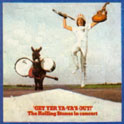 September 4,
1970: The Rolling Stones' second live album, Get Yer
Ya-Ya's Out! The Rolling Stones in Concert, is
released in the UK. (Released in the
US on September 26.)
September 4,
1970: The Rolling Stones' second live album, Get Yer
Ya-Ya's Out! The Rolling Stones in Concert, is
released in the UK. (Released in the
US on September 26.)
| Pete Townshend of The Who (1970):
Ya-Ya's
I think the Stones have really, as as far as I'm concerned, they're really way back on top, and I'm so knocked out! Because I know they probably lost two years of development which would make them just GIANTS by now. But it's so incredible that they can come bouncing back. You know their live sound like on that live album, it's got all that kind of... it's not a GREAT sound and it's not a REAT band playing on it or anything but there's all those dynamics, those kind of little rough edges and those things - I don't know how to put it - the friction and the whole thing is all there, you just get the shiver up your spine. And it's incredible... Let It Bleed is a MASTERPIECE - beats Beggars Banquet which I thought would've been very difficult to do. |
September 10, 1970: Mick
Jagger, Keith Richards and Mick Taylor appear on Danish
radio, spinning records.
September 14-20, 1970:
The Rolling Stones tour West Germany, performing in Hamburg,
West Berlin,
Cologne
and, for the first time, Stuttgart.
September 19, 1970: Mick
Jagger's version of Memo From Turner is released
on the soundtrack album to
Performance.
September 22-24, 1970:
The Rolling Stones perform at the Palais des sports in
Paris, France.
September 23, 1970: At a
party after a concert in Paris, Mick Jagger is introduced
to his future wife, Bianca Rose
Perez
Moreno de Macias. Bianca follows the group for the rest of
their tour.
| Donald Cammell: prsenting Mick and
Bianca
(Bianca) was an old style courtesan, the sort who was always basically saying to herself, Well, who's going to be paying the rent five years from now? But she had set her cap at him, and was determined, so I engineered a meeting. I procured Mick for Bianca. As I introduced them, I said, You two are going to have a great romance, you were made for each other. |
September 27-October 3,
1970: The Rolling Stones perform in Vienna, Austria, then in
Rome and Milan
in
Italy, then Lyon in France.
| Jo Bergman, Stones' assistant: Keith
Richards' heroin habit
I never noticed anything about Keith particularly till 1970, and then not so much Keith as with Anita. Anita was violently ill. It was quite noticeable. By '72 it was VERY noticeable. I didn't think Keith was going to live through the '70 tour of Europe. |
October 5-9, 1970: The
Rolling Stones conclude their European Tour with more
concerts in West
Germany
- Frankfurt (for the first time) and Essen -, and
their first performance in Amsterdam,
The
Netherlands.
| Mick Jagger (1971): Touring and
money
(W)e've got to start cutting down, you know, because it just gets so expensive. I mean, it's like we've really worked and worked and worked and then, at the end of it, you've got people saying, Well, I paid too much to get it, and then I'm saying, Well, we spent it all in transportation. Do you know what I mean? That's what happens. And people get angry. Especially that European tour, the ticket prices were rather high. We actually had nothing at the end of it because... we had a bigger crew and like it was a much bigger presentattion than anything we'd done in America, and the places weren't as big and the tickets were't as expensive. So we came out with nothing. Which we knew before we started but you can't do that all the time. |
October 17-November 2,
1970: The Rolling Stones resume recording sessions at Mick
Jagger's home
Stargroves
in
Newbury, working on Bitch, Tumbling Dice, Sweet
Black Angel, Hide Your Love,
Moonlight Mile and Sway, among others.
| Mick Jagger: Recording with Mick
Taylor
We made (tracks) with just Mick Taylor, which are very good and everyone loves, where Keith wasn't there for whatever reasons... People don't know that Keith wasn't there making it. All the stuff like Moonlight Mile, Sway. These tracks are a bit obscure, but they are liked by people that like the Rolling Stones. It's me and (Mick Taylor) playing off each other - another feeling completely, because he's following my vocal lines and then extemporizing on them during the solos. |
| Shirley Arnold, Stones' secretary:
The Stargroves sessions
They could hardly get any work done, with Mick the way he was about Bianca. She'd come into the studio and give him the eye... he'd leave the other Stones and follow her upstairs. |
November 4, 1970: Marsha Hunt
gives birth to Mick Jagger's first child, a daughter,
Karis.
November
15-25, 1970: Mick Taylor helps John Mayall record his next
album, Back To The Roots, at IBC Studios
in London.
November 24, 1970: Mick
Jagger and Bianca Moreno de Macias travel to the Bahamas
for a party thrown by
Atlantic Records President Ahmet Ertegun and a holiday.
December 1970:
Overdub/mixing sessions are held for Sticky Fingers
at Olympic Sound Studios in
London,
England. Pete Townshend, Ronnie Lane and Billy Nicholls add
backing vocals to Sway.
December 6, 1970: The
documentary/concert movie filmed by the Maysles Brothers
of the Stones' 1969 tour and
Altamont, Gimme Shelter, is premiered in New York
City.
December 31, 1970: Charlie
Watts attends Ringo Starr's New Year's Eve party at Ronnie
Scott's in London, where
they
jam along with Eric Clapton, Bobby Keys, Klaus Voormann,
Maurice Gibb and Georgie Fame. Charlie
Watts
and Ringo Starr play drums together.