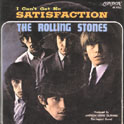
Probable line-up:
Drums: Charlie
Watts
Bass: Bill
Wyman
Acoustic guitar: Keith
Richards or
Brian Jones
Electric guitar: Keith Richards
Lead vocal: Mick Jagger
Background vocals: Mick Jagger & Keith Richards
Piano: Jack
Nitzsche
Tambourine: Jack Nitzsche
I can't get no
satisfaction
I can't
get no satisfaction
Cause I tried
and I tried
And I tried
and I tried
I can't
get no
I can't get no
When
I'm driving in my car
And a man
comes on the radio
He's telling me more and more
About some
useless information
Supposed to fire my imagination
I can't get no
No, no, no
Hey,
hey, hey
That's what I
say
I can't get no
satisfaction
I can't
get no satisfaction
Cause I tried
and I tried
And I tried
and I tried
I can't
get no
I can't get no
When
I'm watching my TV
And a man
comes on that tells me
How white my shirts can be
But he can't
be a man 'cause he doesn't smoke
The same cigarettes as me
I can't get no
No, no, no
Hey,
hey, hey
That's what I
say
I can't get no satisfaction
I can't get no
girl reaction
Cause I tried
and I tried
And I tried
and I tried
I can't
get no
I can't get no
When I'm
riding around the world
And I'm doing
this and I'm signing that
And I'm trying to make some girl
Who tells
me Baby, better come back
maybe next week
'cause you see I'm on a losing
streak
I can't get no
No, no, no
Hey,
hey, hey
That's what I
say
I can't
get no
I can't get no
I can't get no
No
satisfaction
No satisfaction
No
satisfaction
No satisfaction
I can't get no...
TrackTalk
It was just a riff. I didn't think... I
didn't think of it as... I woke up in the middle of the night,
put it down on a cassette. I thought it was great then. Went
to sleep and when I woke up, it appeared to be as useful as
another album track. It was the same with Mick too at the
time, you know. It goes da-da, da-da-da... and the
words I'd written for that riff were I can't get no
satisfaction. But it could just as well have been
Auntie Millie's Caught Her Left Tit in the Mangle.
- Keith Richards
It sounded like a folk song when we first
started working on it and Keith didn't like it much, he didn't
want it to be a single, he didn't think it would do very
well... I think Keith thought it was a bit basic. I don't
think he really listened to it properly. He was too close to
it and just felt it was a silly kind of riff... (We wrote it
in) Tampa, Florida, by a swimming pool.
- Mick Jagger, 1968
Keith wrote the lick. I think he had this
lyric, I can't get no satisfaction, which, actually, is
a line in a Chuck
Berry song called 30 Days... I can't get no
satisfaction from the judge... (T)hat was just one line,
and then I wrote the rest of it. There was no melody, really.
- Mick Jagger, 1995
I remember vividly making Satisfaction.
It was at RCA in Los Angeles, in the same studio where Duke
Ellington recorded one of the greatest records he ever made, Ellington
Uptown, with Louie Bellson on drums: that's the famous A
Train track. Dave Hassinger, the engineer, used to smoke
Tiparillos constantly. He seemed a lot older, like a man,
while we were still boys. And LA was like Wow!.
- Charlie Watts, 2003
(T)hat riff needed to sustain itself and
Gibson had just brought out these little (distortion) boxes
so... But the riff was in essence not meant for the guitar. Otis Redding got it
right when HE later recorded it because it's actually a horn
riff. I never thought that was song was commercial anyway.
Shows how wrong you can be.
- Keith Richards
Whatever it was, it was the first
(fuzztone box) Gibson made. I was screaming for more
distortion: This riff's really gotta hang hard and long,
and we burnt the amps up and turned the shit up, and it still
wasn't right. And then Ian
Stewart went around the corner to Eli Wallach's Music
City or something and came around with a distortion box.
Try this. It was as off-hand as that. It was just from
nowhere. I never got into the thing after that, either. It had
a very limited use, but it was just the right time for that
song.
- Keith Richards,
September 1992
I didn't think much of Satisfaction
when we first recorded it. We had a harmonica on then and it
was considered to be a good B-side or maybe an LP track.
- Keith Richards, 1965
With Satisfaction I got the fuzz
tone and I thought we'd already finished all the tracks that
we wanted to cut. So this was just a little sketch, because,
to my mind, the fuzz tone was really there to denote what the
horns would be doing. But Andrew spotted the spirit of the
track and we were already back on the road before we heard
that they'd decided that Satisfaction was going to be
the single. We had thought we were going to cut a better
version. It was still not fisnished as far as we were
concerned, but sometinmes an artist's skcetches are better
than the finished painting, and that's probably one of the
perfect examples.
- Keith Richards, 2003
After we listened to the master, we
discussed whether or not it should be the next single. Andrew
and Dave Hassinger were very positive about it, so we put it
to the vote. Andrew, Dave, Stu, Brian, Charlie and I voted
yes, while Mick and Keith voted no. It became the next single
by the majority vote.
- Bill Wyman, Rolling
With The Stones, 2002
I never heard the damn lyrics to Satisfaction
for years. They kept telling me to bring the voice down
more and more into the track. I thought they were crazy. I
didn't know it had to do with the lyric and getting radio
play.
- Dave Hassinger, 1979
Girlie action was really Girl
reaction. The dirtiest line in Satisfaction they
don't understand, see? It's about You better come back
next week cause you see I'm on a losing streak. But
(people) don't get that. It's just life. That's really what
happens to girls. Why shouldn't people write about it?
- Mick Jagger, 1966
People get very blasé about their big hit.
It was the song that really made the Rolling Stones, changed
us from just another band into a huge, monster band. You
always need one song. We weren't American, and America was a
big thing and we always wanted to make it here. It was very
impressive the way that song and the popularity of the band
became a worldwide thing...
- Mick Jagger, 1995
I remember hearing Satifaction on
the bus radio. I was enjoying the fact that people like Otis
Redding covered it. And when we play it today live we still
have that essence of the soulful treatment that Otis gave Satisfaction.
- Ron Wood, 2003
I couldn't sit down and write anything
like I can't get no, no, no, no... any more. All that
was a bit adolescent, but the sense is still true.
- Mick Jagger, 1969
I can play Satifaction today or
tomorrow and still find new stuff in there, and little
nuances. And the way to play it with these guys, you know,
which is important. Because you never play it the same
twice... Songs are difficult things to talk about because you
never know where they start. And then when you've been playing
them for 30 odd years (laughs) you're never quite sure where
they end either. They keep changing on you.
- Keith Richards, 2003
It’s the riff of all time. I’m still
finding how to tighten it up. Darryl and I are working on the
rhythm end lately — slightly different ideas to make it
snappier and better.
- Keith Richards, 2019
It's a signature tune, really, rather than a
great, classic painting, 'cause it's only like one thing - a
kind of signature that everyone knows. It has a very catchy
title. It has a very catchy guitar riff. It has a great guitar
sound, which was original at that time. And it captures a spirit
of the times, which is very important in those kinds of songs...
Which was alienation. Or it's a bit more than that, maybe, but a
kind of sexual alienation. Alienation's not quite the
right word, but it's one word that would do.
- Mick Jagger, 1995
Back to TrackTalk Menu.
Back to Out of Our Heads.
Back to Main Page.