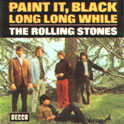
Probable line-up:
Drums: Charlie Watts
Bass: Bill Wyman
Acoustic guitars: Keith Richards & Brian
Jones
Electric guitar: Keith Richards
Lead vocal: Mick Jagger
Background vocals: Mick Jagger & Keith
Richards
Sitar: Brian Jones
Organ pedals: Bill Wyman
Piano: Jack
Nitzsche
Percussion: Mick Jagger
I
see a red door and I want it painted black
No
colors
anymore, I want them to turn black
I see the girls walk by
Dressed in their summer clothes
I
have to turn my head
Until my darkness goes
I see a line of cars and they're all painted
black
With
flowers
and my love both never to come back
I see people turn their heads
And quickly look away
Like
a
newborn baby
It just happens every day
I look inside myself and see my heart is black
I
see my red door, I must have it painted black
Maybe then I'll fade away
And not have to face the facts
It's
not
easy facing up
When your whole world is black
No more will my green sea go turn a deeper blue
I
could not foresee this thing happening to you
If I look hard enough
Into the setting sun
My
love
will laugh with me
Before the morning comes
I see a red door and I want it painted black
No
colors
anymore, I want them to turn black
I see the girls walk by
Dressed in their summer clothes
I
have to turn my head
Until my darkness goes
I want to see it painted, painted black
Black as night, black as coal
I
want to see the sun
Blotted out from the sky
I
want to see it painted, painted, painted
Painted black - yeah
TrackTalk
I must say in retrospect
that actually what made Paint It Black was Bill Wyman on
the organ, because it didn't sound anything like the finished
record, until Bill said, You go like this.
- Keith Richards,
2003
Mick wrote it. I wrote the music, he did the words. Get a single
together... What's amazing about that one for me is the sitar.
Also, the fact that we cut it as a comedy track. Bill was
playing an organ, doing a takeoff of our first manager (Eric
Easton) who started his career in show business as an organist
in a cinema pit. We'd been doing it with funky rhythms and it
hadn't worked and he started playing it like this and everybody
got behind it. It's a two-beat, very strange. Brian playing the
sitar makes it a whole other thing.
- Keith Richards,
1971
Paint It Black was just going to be like a beat group
number. If you'd been at the session it was like one big joke.
We put Bill on piano and Bill plays in this funny style. He goes
bi-jing, bi-jing, bi-jing, and all that sort of stuff and
we went running about going bi-jing, bi-jing, bi-jing and
that's how it all started. It was just one big joke. It was in
Los Angeles. And we just stuck the sitar on because some geezer
came in. He was in a jazz group playing sitar in his pyjamas.
And we said Oh, that'll sound good because it's got this
thing that goes "g-doing, doing, doing", etc.
- Mick Jagger, 1966
Paint It Black was like songs for Jewish weddings at the
beginning!
- Mick Jagger,
December 1992
The organ-playing story (that Bill was doing a take-off on Eric
Easton) is complete fiction, actually. What really happened was
that I had put a bass track and then another bass on top of
that, but the sound still wasn't fat enough, it needed something
on the bottom end. I wanted to play organ very loud on it to
fill the sound. I tried playing the organ pedals with my feet
but the pedals kept sticking so I got down on the floor and hit
them with my fists. I actually never touched the keyboard. If
anything it was a bit of an in-joke because Eric Easton was a
keyboard player and I was just playing the pedals.
- Bill Wyman
(Bill) was... instrumental on Paint It Black, adding
organ pedals to the bottom end.
- Keith Richards,
2002
On Paint It Black the drum pattern might have been
suggested by Mick and I'd try it that way, or we'd be listening
to a certain record at the time - it could have been anything
like Going to a Go-Go. Engineers never like recording
ride cymbals in those days. We all used to have the kind that
Art Blakey used, with the inch-long or so rivets, so the cymbals
would cover everything, and the engineers would go mad.
- Charlie Watts, 2003
We were in Fiji for about 3 days... They make sitars and all
sorts of Indian stuff. Sitars are made out of watermelons or
pumpkins or something smashed so they go hard. They're very
brittle and you have to be careful how you handle them. Brian's
cracked his already. And we had the sitars, we thought we'd try
them out in the studio. To get the right sound on Paint It
Black we found the sitar fitted perfectly. We tried a
guitar but you can't bend it enough.
- Keith Richards,
1966
On Paint It Black, I used a flattened third in fret
position. The sound you get from a sitar is a basic blues
pattern, which results in the flattening of the third and
seventh as a result of the super-imposition of primitive Eastern
pentatonic scales on the well-known Western diatonic.
- Brian Jones, 1966
What utter rubbish. You might as well say that we copy all the
other groups by playing guitar. Also, everyone asks if it's
going to be the new trend. Well, personally, I wouldn't like it
to be. You don't have to get that weird Indian sound from a
sitar. Take Norwegian Wood. Atmospherially, it's my
favourite track by the Beatles. George made simple use of the
sitar and it was very effective.
- Brian Jones, 1966,
on copying the Beatles' use of sitar
Paint It Black is very good and very different. It has
that Turkish groove that was really out of nowhere and something
to do with Brian helping the song move along by playing sitar,
which gave that record a particular flavour.
- Mick Jagger, 2003
That song is another one of those semi-gypsy melodies we used to
come up with back then. I don't know where they come from. Must
be in the blood.
- Keith Richards,
2002
It's over-recorded at the end. The electric guitar doesn't sound
quite right to me, the one I play. I should have used a
different guitar; at least, a different sound. And I think it
sounds rushed. I think it sounds as if we've said - as we
actually did - That's great. If we do anymore we'll lose the feel of it.
Because that's what we said, and that's why, I think, if we'd
done a few more takes of it, to my mind it would have been a
slightly better record. But that's very technical; probably what
I would have liked to have heard on it wouldn't have sounded
different to thousands of other people.
- Keith Richards,
1966
Back to TrackTalk Menu.
Back to Main Page.